
New Projects in the Accounting Area
Dear QRCA Community,
We would like to publicize two projects that bring essential reflections on the accounting area. First, the book “Breaking Barriers: (against) reports during the pandemic – Letters for future generations” [in English Breaking Boundaries: (Counter) accounts during a pandemic – Letters for future generations]. Second, the movement “Opening Accounting: A Manifesto.”
The book “Breaking Barriers” was conceived by academics in accounting from three continents and offered a permanent record of the individual and collective experiences of the first months of the COVID-19 pandemic. This multi-lingual book provides a close look into social isolation (or quarantine) and its repercussions through various multimedia and artistic presentations. It offers a unique opportunity to look back into this past (still recent for us) and see how accounting was performed during this period of exception.
The collection consists of 63 contributions by 84 authors and authors, ranging from academics and academics in accounting and social sciences to business professionals, spread across 17 countries around the globe. Not limited to written records, submissions came in articles, essays, visual arts, multimedia presentations, and prose in English, French, Spanish, and Portuguese.
The book is available for free in digital format. “Breaking Barriers” is published under the Creative Commons license through Scholarship@Western.
The collection is available for free through the link: https://ir.lib.uwo.ca/breaking-boundaries/
The “Opening Accounting” project advocates for a more diverse accounting beyond the narrow focus on capital markets. Its academic professionals adopt a more progressive mentality. The manifesto was published in the journal Accounting Forum. The authors developed a video highlighting some points of the manifesto.
To access the written piece, go to: https://www.tandfonline.com/doi/full/10.1080/01559982.2021.1952685
To access the video, go to: https://www.youtube.com/watch?v=zXzc_9TTv_I
Open Calls


Dear QRCA Community,
We would like to announce some Call for Papers opportunities.
- “Accounting Education in Latin America: broadening perspectives and contributions on teaching, learning, and research” in the journal “Accounting Education”;
- “Debating Black Slavery in Management and Organization Studies from Decolonial and Afrodiasporic Perspectives” in the journal “Cadernos EBAPE”;
- “Exhausted Women in Contemporaneity” by Revista de Administração Contemporânea (RAC), Brazil.
The coordination of CfP “Accounting Education in Latin America” is the responsibility of the team of professors from Brazilian and Colombian universities: Silvia Pereira de Castro Casa Nova (USP), Fernanda Filgueiras Sauerbronn (UFRJ), Mary Vera-Colina (Universidad Nacional de Colombia, Colombia), Adriana Maria Procópio de Araujo (USP) and Ruth Alejandra Patiño Jacinto, Universidad Nacional de Colombia, Colombia. In addition, the call has the support of universities from other Latin American countries in its body of reviewers.
Its main objective is “to reflect on the different aspects of Latin American accounting education and research in accounting education. The papers may be related to the nature of the accounting profession in the region, the growth of undergraduate and graduate programs, accounting students, professional development programs, or the effects of implementing global standards and internationalization processes on educational backgrounds (accounting, management accounting, auditing, codes of ethics, and international accounting education standards). Alternatively, it is interested in particular challenges in accounting education and research in Latin America. For example, historical, socioeconomic, and cultural diversity or the high levels of inequality and political instability still significant across the continent”.
The call will receive papers until August 31, 2022.
For more information, access the full call: https://think.taylorandfrancis.com/special_issues/accounting-education-latin-america/?utm_source=TFO&utm_medium=cms&utm_campaign=JPG15743
The CfP “Debating Black Slavery in Management and Organization Studies from Decolonial and Aphrodiasporic Perspectives,” is coordinated by the team of professors: Cintia Cristina Silva de Araujo (FIPECAFI), Alexandre Faria (EBAPE/FGV), Jair N. Santos (UNIFACS and UNEB) and Nidhi Srinivas (The New School USA). It aims to attract papers related to “struggles against the radicalization of slave capitalism in the North and the South, promoting a transformative engagement of black slavery from decolonial and afrodiasporic perspectives […] recognizing the remnants of black slavery in management and organizations and recovering decolonial and afrodiasporic epistemes.”
The call will receive papers until February 28, 2022.
For more information, access the full call: https://bibliotecadigital.fgv.br/ojs/index.php/cadernosebape/call-for-papers-3
Finally, the so-called “Exhausted Women in Contemporaneity” is organized by professors Ludmila de Vasconcelos M. Guimarães (CEFET, MG), Deidi Maca (Universidad Santiago de Cali), Josiane Silva de Oliveira (UFG), Janaynna de Moura Ferraz (UFRN) ), Luiza Farnese Lana Sarayed-Din (UFRJ) and Andrea Poleto Oltramari (UFRGS). It aims to discuss exhaustion and “the fatigue of a historical and daily struggle for gender equality, for the end of harassment and femicide, for the imbalance in the division of domestic tasks, for public policies that support women remain in the labor market so that they feel welcomed and protected in situations of violence, by opportunities and equivalent values in the performance of work activities.”
The call welcomes submissions up to May 30, 2022.
For more information, access the full call: https://rac.anpad.org.br/index.php/rac/announcement/view/52
Don’t miss out on these opportunities to critically discuss essential in Accounting and Management!
Novos Projetos na Área Contábil
Prezada Comunidade QRCA,
Gostaríamos de divulgar dois projetos que trazem importantes reflexões sobre a área contábil: o livro “Rompendo Barreiras: (contra) relatos durante a pandemia – Cartas para as futuras gerações” [em inglês Breaking Boundaries: (Counter) accounts during a pandemic – Letters for future generations] e o movimento “Opening Accounting: A Manifesto”.
O livro “Rompendo barreiras” foi concebido por um grupo de acadêmicos e acadêmicas de contabilidade espalhados por três continentes e oferece um registro permanente das experiências individuais e coletivas dos primeiros meses da pandemia da COVID-19. Por meio de uma variedade de apresentações multimídia e artísticas esse trabalho multi-linguístico oferece uma janela para o período de isolamento social (ou quarentena) e para suas repercussões, proporcionando uma oportunidade única de olhar para esse passado (ainda recente para nós) e enxergar como foi a contabilidade durante esse período de exceção.
A coletânea consiste em 63 contribuições de 84 autores e autoras, que vão desde acadêmicos e acadêmicas de contabilidade e ciências sociais até profissionais de negócios, distribuídos por 17 países ao redor do globo. Não limitadas aos registros escritos, as submissões vieram nas formas de artigos, ensaios, artes visuais, apresentações multimídia e prosa, em quatro línguas: inglês, francês, espanhol e português.
O livro está disponível gratuitamente em formato digital. “Rompendo Barreiras” foi publicado sob a licença Creative Commons por meio da Scholarship@Western.
A coletânea está disponível gratuitamente por meio do link: https://ir.lib.uwo.ca/breaking-boundaries/
Já o projeto “Opening Accounting” advoga por uma contabilidade mais diversa e que vá além do foco estreito nos mercados de capitais e que seus profissionais acadêmicos adotem uma mentalidade mais progressista. O manifesto foi publicado no periódico Accounting Forum e os autores e autoras também desenvolveram um vídeo ressaltando alguns pontos do manifesto.
Para ter acesso ao artigo, acesse: https://www.tandfonline.com/doi/full/10.1080/01559982.2021.1952685
Para ter acesso ao vídeo, acesse: https://www.youtube.com/watch?v=zXzc_9TTv_I
Nuevos Proyectos en el Área Contable
Estimada comunidad QRCA,
Nos gustaría divulgar dos proyectos que aportan importantes reflexiones sobre el área contable: el libro “Rompiendo fronteras”: (Contra) cuentas durante una pandemia – Cartas para las generaciones futuras” (en inglés Breaking Boundaries: (Counter) accounts during a pandemic – Letters for future generations) y el movimiento “Abrir la contabilidad: un manifiesto”.
El libro “Rompiendo fronteras” ha sido concebido por un grupo de académicos contables de tres continentes y ofrece un registro continuo de las experiencias individuales y colectivas de los primeros meses de la pandemia de COVID-19. A través de una variedad de presentaciones multimedia y artísticas, esta obra multilingüe ofrece una ventana al período de aislamiento social (o cuarentena) y sus repercusiones, proporcionando una oportunidad única de mirar hacia atrás en ese pasado (todavía reciente para nosotros) y ver cómo era la contabilidad durante este período de excepción.
La colección consta de 63 contribuciones de 84 autores, desde estudiosos de la contabilidad y las ciencias sociales hasta profesionales de la empresa, repartidos por 17 países de todo el mundo. Las propuestas no se limitaron a las entradas escritas, sino que se presentaron en forma de artículos, ensayos, artes visuales, presentaciones multimedia y prosa, en cuatro idiomas: inglés, francés, español y portugués.
El libro está disponible gratuitamente en formato digital. “Rompiendo fronteras” fue publicado bajo la licencia Creative Commons a través de Scholarship@Western.
La colección está disponible de forma gratuita a través del enlace: https://ir.lib.uwo.ca/breaking-boundaries/
El proyecto “Opening Accounting” aboga por una contabilidad más diversa que vaya más allá del estrecho enfoque de los mercados de capitales y propende porque sus profesionales académicos adopten una mentalidad más progresista. El manifiesto se publicó en la revista Accounting Forum y los autores también elaboraron un vídeo en el que se destacan algunos de los puntos del manifiesto.
Para acceder al artículo, vaya a: https://www.tandfonline.com/doi/full/10.1080/01559982.2021.1952685
Para acceder al vídeo, vaya a: https://www.youtube.com/watch?v=zXzc_9TTv_I
Convocatorias abiertas
Estimada comunidad QRCA,
Ya están abiertas las siguientes convocatorias: la convocatoria de trabajos “Accounting Education in Latin America: broadening perspectives and contributions on teaching, learning, and research” de la revista “Accounting Education”; la convocatoria de trabajos para el número especial “Debate sobre la esclavitud negra en los estudios de gestión y organización desde perspectivas decoloniales y afrodiaspóricas” de la revista “Cadernos EBAPE”; y la convocatoria de trabajos “Mujeres agotadas en la sociedad contemporánea” de la Revista de Administración Contemporánea (RAC).
La coordinación de la convocatoria “Accounting Education in Latin America: broadening perspectives and contributions on teaching, learning, and research” está a cargo de un equipo de profesores de universidades brasileñas y colombianas: Silvia Pereira de Castro Casa Nova (USP), Fernanda Filgueiras Sauerbronn (UFRJ), Mary Vera-Colina (Universidad Nacional de Colombia, Colombia), Adriana Maria Procópio de Araujo (USP) y Ruth Alejandra Patiño Jacinto (Universidad Nacional de Colombia, Colombia). Además, la convocatoria cuenta con el apoyo de universidades de otros países latinoamericanos en su cuerpo de revisores.
Su principal objetivo es “reflexionar sobre los diversos aspectos de la enseñanza de la contabilidad en América Latina y la investigación sobre la enseñanza de la contabilidad”. Puede tratarse de cuestiones relacionadas con la naturaleza de la profesión contable en la región, el crecimiento de los programas de grado y posgrado, los estudiantes de contabilidad, los programas de desarrollo profesional, o los efectos de la aplicación de las normas mundiales y los procesos de internacionalización en la formación (contabilidad financiera, contabilidad de gestión, auditoría, códigos de ética y normas internacionales de enseñanza de la contabilidad). También nos interesan los desafíos particulares de la educación e investigación contable en América Latina, por ejemplo, debido a la diversidad histórica, socioeconómica y cultural o a los altos niveles de desigualdad e inestabilidad política que todavía son desafíos importantes que se enfrentan en muchos entornos del continente.”
La convocatoria recibirá trabajos hasta el 31 de agosto de 2022.
Para más información, acceda a la convocatoria completa: https://think.taylorandfrancis.com/special_issues/accounting-education-latin-america/?utm_source=TFO&utm_medium=cms&utm_campaign=JPG15743
La convocatoria “Debate sobre la esclavitud negra en los estudios de gestión y organización desde perspectivas decoloniales y afrodiaspóricas” está coordinada por el equipo de profesores Cintia Cristina Silva de Araujo (FIPECAFI), Alexandre Faria (EBAPE/FGV), Jair N. Santos (UNIFACS y UNEB) y Nidhi Srinivas (The New School USA). El objetivo de la convocatoria es “comprometer a una población creciente que lucha contra la radicalización del capitalismo esclavista en el Norte y el Sur, promoviendo un compromiso transformador de la esclavitud negra con los OE desde perspectivas decoloniales y afrodiaspóricas […] reconociendo los remanentes de la esclavitud negra en la gestión y las organizaciones y recuperando las epistemes decoloniales y afrodiaspóricas”.
La convocatoria recibirá trabajos hasta el 28 de febrero de 2022.
Para más información, acceda a la convocatoria completa: https://bibliotecadigital.fgv.br/ojs/index.php/cadernosebape/call-for-papers-3
Por último, la convocatoria “Mujeres agotadas en las sociedades contemporáneas” está organizada por las profesoras Ludmila de Vasconcelos M. Guimarães (CEFET, MG), Deidi Maca (Universidad Santiago de Cali), Josiane Silva de Oliveira (UFG), Janaynna de Moura Ferraz (UFRN), Luiza Farnese Lana Sarayed-Din (UFRJ) y Andrea Poleto Oltramari (UFRGS). La convocatoria pretende debatir sobre el agotamiento en lo que se refiere al “cansancio de una lucha histórica y cotidiana por la igualdad de género, por el fin del acoso y el feminicidio, por un reparto desequilibrado de las tareas domésticas, por políticas públicas de apoyo a la permanencia de las mujeres en el mercado laboral, por sentirse acogidas y protegidas en situaciones de violencia, por oportunidades y valoraciones equivalentes en el desempeño de las actividades laborales”.
La convocatoria recibirá propuestas hasta el 30 de mayo de 2022.
Para más información, acceda a la convocatoria completa: https://rac.anpad.org.br/index.php/rac/announcement/view/52
¡No se pierda estas oportunidades de discutir temas tan relevantes para reflexionar críticamente sobre las áreas de Contabilidad y Gestión!
Chamadas abertas
Prezada Comunidade QRCA,
Estão abertas as chamadas “Accounting Education in Latin America: broadening perspectives and contributions on teaching, learning, and research” do periódico “Accounting Education”; a chamada de artigos para o número especial “Debatendo a escravidão negra nos Estudos em Gestão e Organização a partir de perspectivas decoloniais e afrodiaspóricas” do periódico “Cadernos EBAPE”; e a chamada de artigos “Mulheres Exaustas na Contemporaneidade” da Revista de Administração Contemporânea (RAC).
A coordenação da chamada “Accounting Education in Latin America: broadening perspectives and contributions on teaching, learning, and research” fica por conta do time de professoras de universidades brasileiras e colombianas: Silvia Pereira de Castro Casa Nova (USP), Fernanda Filgueiras Sauerbronn (UFRJ), Mary Vera-Colina (Universidad Nacional de Colombia, Colombia), Adriana Maria Procópio de Araujo (USP) e Ruth Alejandra Patiño Jacinto, Universidad Nacional de Colombia, Colombia. Além disso, a chamada conta com o apoio de universidades dos outros países da américa latina no seu corpo de pareceristas.
Seu principal objetivo é “refletir sobre os diversos aspectos da educação contábil latino-americana e da pesquisa em educação contábil. Estas podem ser questões relacionadas com a natureza da profissão contábil na região, o crescimento dos programas de graduação e pós-graduação, estudantes de contabilidade, programas de desenvolvimento profissional ou os efeitos da implementação de padrões globais e processos de internacionalização em formações educacionais (contabilidade financeira, contabilidade gerencial, auditoria, códigos de ética e padrões internacionais de educação contábil). Alternativamente, estamos interessados em desafios particulares na educação e pesquisa contábil na América Latina, por exemplo, devido à diversidade histórica, socioeconômica e cultural ou aos altos níveis de desigualdade e instabilidades políticas que ainda são desafios significativos enfrentados em muitos ambientes do continente”.
A chamada receberá trabalhos até 31 de agosto de 2022.
Para maiores informações acesse a chamada na íntegra: https://think.taylorandfrancis.com/special_issues/accounting-education-latin-america/?utm_source=TFO&utm_medium=cms&utm_campaign=JPG15743
Já a chamada “Debatendo a escravidão negra nos Estudos em Gestão e Organização a partir de perspectivas decoloniais e afrodiaspóricas” é coordenada pelo time de docentes composto por Cintia Cristina Silva de Araujo (FIPECAFI), Alexandre Faria (EBAPE/FGV), Jair N. Santos (UNIFACS e UNEB) e Nidhi Srinivas (The New School USA). O objetivo da chamada é “envolver uma população crescente que luta contra a radicalização do capitalismo escravista no Norte e no Sul, promovendo um envolvimento transformador da escravidão negra com os EGO a partir de perspectivas decoloniais e afrodiaspóricas […] reconhecendo os resquícios da escravidão negra na gestão e nas organizações e recuperando epistemes decoloniais e afrodiaspóricas.”
A chamada receberá trabalhos até 28 de fevereiro de 2022.
Para maiores informações acesse a chamada na íntegra: https://bibliotecadigital.fgv.br/ojs/index.php/cadernosebape/call-for-papers-3
Por fim, a chamada “Mulheres Exaustas na Contemporaneidade” é organizada pelas professoras Ludmila de Vasconcelos M. Guimarães (CEFET, MG), Deidi Maca (Universidad Santiago de Cali), Josiane Silva de Oliveira (UFG), Janaynna de Moura Ferraz (UFRN), Luiza Farnese Lana Sarayed-Din (UFRJ) e Andrea Poleto Oltramari (UFRGS). A chamada tem o objetivo de discutir exaustão no que se refere “ao cansaço de uma luta histórica e cotidiana pela igualdade de gênero, pelo fim do assédio e do feminicídio, pelo desequilíbrio da divisão de tarefas domésticas, por políticas públicas que deem suporte para que as mulheres se mantenham no mercado de trabalho, para que se sintam acolhidas e protegidas em situações de violência, por oportunidades e valorizações equivalentes no desempenho das atividades laborais”.
A chamada receberá submissões até 30 de Maio de 2022.
Para maiores informações acesse a chamada na íntegra: https://rac.anpad.org.br/index.php/rac/announcement/view/52
Não percam essas oportunidades de discutirem esses temas tão relevantes para pensar criticamente as áreas de Contabilidade e Administração!
Southern Accounts – Critical Perspectives On Accounting – Special Issue Call for Papers at CPA
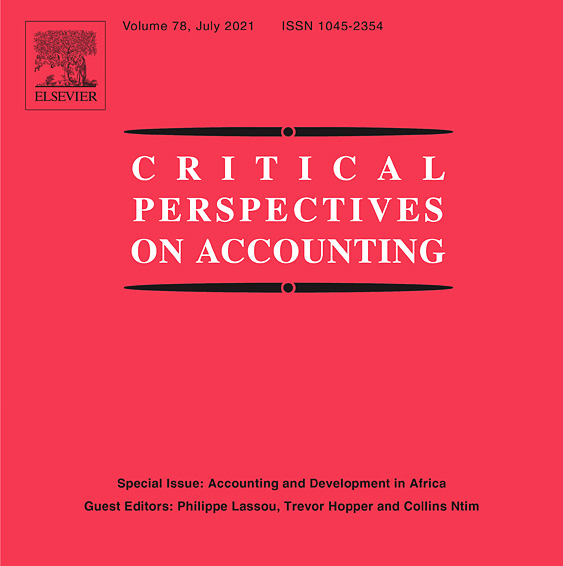
Critical Perspectives on Accounting
Special issue
Southern Accounts
Guest editors:
Daniel Martinez, HEC Paris
Dean Neu, York University
Abu Rahaman, University of Calgary
Fernanda Sauerbronn, Universidade Federal do Rio de Janeiro
Despite our belief in a ‘community of critical accounting scholars’, critical accounting scholarship is partitioned, bounded and stratified in many of the same ways that are other forms of academic research. Critical accounting research is bounded by what counts as acceptable research, by the theorists that it must engage with, and by how research must be positioned to be deemed to make a contribution (Gendron & Rodrigue, 2019). This special issue is a call to break these boundaries and to engage with the ‘South’ on its own terms.
The special issue aspires to be part of a larger program of “epistemic disobedience” (Quijano, 1992; Mignolo, 2011) that exposes us to “alternatives of inquiry and forms of engagement” (Sauerbronn et al., in press) and that challenges the colonial legacies that inform the production of accounting research. Our objective is to incite research that is sensitive to the lived experiences and research traditions that abound in the South and to encourage conversations about what counts as useful research. For the special issue editors, the notion of useful includes research that explicitly considers how accounting ‘works’ in non-North settings. Similarly, research that starts from conceptual and methodological traditions whose genealogy is not tethered to the canonical texts of Western thought creates the opportunity to move beyond the all-to-common North-South, center-periphery knowledge relationships. Finally, research that explicitly makes visible the ‘biases’ of North-centric research offers an important corrective to prevailing norms of critical accounting research. Stated simply, the special issue is a call to decolonize accounting and to expose critical accounting research to forms of injurious engagement that are under-valued and underrepresented within our community.
While our call aims to decolonize and destabilize critical accounting research, Critical Perspectives on Accounting, since its first editorial three decades ago, has sought to encourage these very sorts of research and to provide a space for “new forms of dialogue and tolerance;” and for research that is “eclectic and interdisciplinary” (Cooper & Tinker, 1990). This call for papers on the South is both a continuation of these efforts and a call to do critical accounting research differently.
Submissions that engage with Southern accounts in all its forms are welcome. We are open to submissions that investigate any type of setting and engage with any intellectual and research tradition from the South. Authors should also not feel obliged to justify the significance of the research tradition by referencing North-specific canonical texts, problematics, and definitions of accounting. More specifically, the special issue is an opportunity for authors to share the ecosystem of concepts, epistemologies, methodologies, literatures, oral traditions, and practices that are part of their critical accounting research tradition with the international critical accounting community.
Workshop
We expect to hold an online workshop in June 2022. Authors interested in submitting their article to the workshop can contact the guest editors and submit a draft by April 8, 2022. Articles selected to present at the workshop will be invited to submit a revised version to the special issue and follow the normal review process. Participation in the workshop is however not mandatory for submission to the special issue.
Submission process
The deadline for submissions to this special issue is December 30, 2022. Manuscripts should be submitted electronically via https://www.journals.elsevier.com/critical-perspectives-on-accounting. Given the aim of the special issue, papers can be submitted in English, Portuguese, Spanish, or French (please contact the editors if you want to submit in a language other than these). Once the manuscript has gone through the review process and been selected for publication in the special issue, its authors will need to translate it into English before publication. The translation to English will be at the authors’ expense. It is expected that the quality of the translation will meet proper standards and will as such be subject to a validation process by the editors. While the English version of the manuscript will be published in the special issue, the submission in its original language will be published as supplementary online material. More information on the journal’s language policy can be found in Andrew, Cooper, and Gendron (2020).
It is anticipated that this special issue will be published in 2024-25.
Please direct any enquiries you may have about the special issue to all the editors:
- Daniel Martinez martinez@hec.fr
- Dean Neu dneu@schulich.yorku.ca
- Abu Rahaman abu.rahaman@haskayne.ucalgary.ca
- Fernanda Sauerbronn fernanda.sauerbronn@facc.ufrj.br
References
Andrew, J., Cooper, C., & Gendron, Y. (2020). Addressing the English language hegemony problem in academia: An ongoing experiment and preliminary policy. Critical Perspectives on Accounting, 69, Article 102127. https://doi.org/10.1016/j.cpa.2019.102127
Cooper, D. J., & Tinker, T. (1990). Editorial. Critical Perspectives on Accounting, 1(1), 1–3.
Gendron, Y., & Rodrigue, M. (2019). On the centrality of peripheral research and the dangers of tight boundary gatekeeping. Critical Perspectives on Accounting, 1–17. http://doi.org/10.1016/j.cpa.2019.02.003
Mignolo, W. D. (2011). Epistemic disobedience and the decolonial option: A manifesto. Transmodernity (Fall), 44-66.
Quijano, A. (1992). Colonialidad y modernidad/racionalidad. Perú Indígena, 13(29), 11-20
Sauerbronn, F. F., Ayres, R. M., da Silva, C. M., & Lourenço, R. L. (in press). Decolonial studies in accounting? Emerging contributions from Latin America. Critical Perspectives on Accounting. https://doi.org/10.1016/j.cpa.2020.102281
Southern Accounts – Critical Perspectives On Accounting – Special Issue Call for Papers at CPA
Critical Perspectives on Accounting
Special issue
Southern Accounts
Guest editors:
Daniel Martinez, HEC Paris
Dean Neu, York University
Abu Rahaman, University of Calgary
Fernanda Sauerbronn, Universidade Federal do Rio de Janeiro
Despite our belief in a ‘community of critical accounting scholars’, critical accounting scholarship is partitioned, bounded and stratified in many of the same ways that are other forms of academic research. Critical accounting research is bounded by what counts as acceptable research, by the theorists that it must engage with, and by how research must be positioned to be deemed to make a contribution (Gendron & Rodrigue, 2019). This special issue is a call to break these boundaries and to engage with the ‘South’ on its own terms.
The special issue aspires to be part of a larger program of “epistemic disobedience” (Quijano, 1992; Mignolo, 2011) that exposes us to “alternatives of inquiry and forms of engagement” (Sauerbronn et al., in press) and that challenges the colonial legacies that inform the production of accounting research. Our objective is to incite research that is sensitive to the lived experiences and research traditions that abound in the South and to encourage conversations about what counts as useful research. For the special issue editors, the notion of useful includes research that explicitly considers how accounting ‘works’ in non-North settings. Similarly, research that starts from conceptual and methodological traditions whose genealogy is not tethered to the canonical texts of Western thought creates the opportunity to move beyond the all-to-common North-South, center-periphery knowledge relationships. Finally, research that explicitly makes visible the ‘biases’ of North-centric research offers an important corrective to prevailing norms of critical accounting research. Stated simply, the special issue is a call to decolonize accounting and to expose critical accounting research to forms of injurious engagement that are under-valued and underrepresented within our community.
While our call aims to decolonize and destabilize critical accounting research, Critical Perspectives on Accounting, since its first editorial three decades ago, has sought to encourage these very sorts of research and to provide a space for “new forms of dialogue and tolerance;” and for research that is “eclectic and interdisciplinary” (Cooper & Tinker, 1990). This call for papers on the South is both a continuation of these efforts and a call to do critical accounting research differently.
Submissions that engage with Southern accounts in all its forms are welcome. We are open to submissions that investigate any type of setting and engage with any intellectual and research tradition from the South. Authors should also not feel obliged to justify the significance of the research tradition by referencing North-specific canonical texts, problematics, and definitions of accounting. More specifically, the special issue is an opportunity for authors to share the ecosystem of concepts, epistemologies, methodologies, literatures, oral traditions, and practices that are part of their critical accounting research tradition with the international critical accounting community.
Workshop
We expect to hold an online workshop in June 2022. Authors interested in submitting their article to the workshop can contact the guest editors and submit a draft by April 8, 2022. Articles selected to present at the workshop will be invited to submit a revised version to the special issue and follow the normal review process. Participation in the workshop is however not mandatory for submission to the special issue.
Submission process
The deadline for submissions to this special issue is December 30, 2022. Manuscripts should be submitted electronically via https://www.journals.elsevier.com/critical-perspectives-on-accounting. Given the aim of the special issue, papers can be submitted in English, Portuguese, Spanish, or French (please contact the editors if you want to submit in a language other than these). Once the manuscript has gone through the review process and been selected for publication in the special issue, its authors will need to translate it into English before publication. The translation to English will be at the authors’ expense. It is expected that the quality of the translation will meet proper standards and will as such be subject to a validation process by the editors. While the English version of the manuscript will be published in the special issue, the submission in its original language will be published as supplementary online material. More information on the journal’s language policy can be found in Andrew, Cooper, and Gendron (2020).
It is anticipated that this special issue will be published in 2024-25.
Please direct any enquiries you may have about the special issue to all the editors:
- Daniel Martinez martinez@hec.fr
- Dean Neu dneu@schulich.yorku.ca
- Abu Rahaman abu.rahaman@haskayne.ucalgary.ca
- Fernanda Sauerbronn fernanda.sauerbronn@facc.ufrj.br
References
Andrew, J., Cooper, C., & Gendron, Y. (2020). Addressing the English language hegemony problem in academia: An ongoing experiment and preliminary policy. Critical Perspectives on Accounting, 69, Article 102127. https://doi.org/10.1016/j.cpa.2019.102127
Cooper, D. J., & Tinker, T. (1990). Editorial. Critical Perspectives on Accounting, 1(1), 1–3.
Gendron, Y., & Rodrigue, M. (2019). On the centrality of peripheral research and the dangers of tight boundary gatekeeping. Critical Perspectives on Accounting, 1–17. http://doi.org/10.1016/j.cpa.2019.02.003
Mignolo, W. D. (2011). Epistemic disobedience and the decolonial option: A manifesto. Transmodernity (Fall), 44-66.
Quijano, A. (1992). Colonialidad y modernidad/racionalidad. Perú Indígena, 13(29), 11-20
Sauerbronn, F. F., Ayres, R. M., da Silva, C. M., & Lourenço, R. L. (in press). Decolonial studies in accounting? Emerging contributions from Latin America. Critical Perspectives on Accounting. https://doi.org/10.1016/j.cpa.2020.102281
Southern Accounts – Critical Perspectives On Accounting – Special Issue Call for Papers at CPA
Critical Perspectives on Accounting
Special issue
Southern Accounts
Guest editors:
Daniel Martinez, HEC Paris
Dean Neu, York University
Abu Rahaman, University of Calgary
Fernanda Sauerbronn, Universidade Federal do Rio de Janeiro
Despite our belief in a ‘community of critical accounting scholars’, critical accounting scholarship is partitioned, bounded and stratified in many of the same ways that are other forms of academic research. Critical accounting research is bounded by what counts as acceptable research, by the theorists that it must engage with, and by how research must be positioned to be deemed to make a contribution (Gendron & Rodrigue, 2019). This special issue is a call to break these boundaries and to engage with the ‘South’ on its own terms.
The special issue aspires to be part of a larger program of “epistemic disobedience” (Quijano, 1992; Mignolo, 2011) that exposes us to “alternatives of inquiry and forms of engagement” (Sauerbronn et al., in press) and that challenges the colonial legacies that inform the production of accounting research. Our objective is to incite research that is sensitive to the lived experiences and research traditions that abound in the South and to encourage conversations about what counts as useful research. For the special issue editors, the notion of useful includes research that explicitly considers how accounting ‘works’ in non-North settings. Similarly, research that starts from conceptual and methodological traditions whose genealogy is not tethered to the canonical texts of Western thought creates the opportunity to move beyond the all-to-common North-South, center-periphery knowledge relationships. Finally, research that explicitly makes visible the ‘biases’ of North-centric research offers an important corrective to prevailing norms of critical accounting research. Stated simply, the special issue is a call to decolonize accounting and to expose critical accounting research to forms of injurious engagement that are under-valued and underrepresented within our community.
While our call aims to decolonize and destabilize critical accounting research, Critical Perspectives on Accounting, since its first editorial three decades ago, has sought to encourage these very sorts of research and to provide a space for “new forms of dialogue and tolerance;” and for research that is “eclectic and interdisciplinary” (Cooper & Tinker, 1990). This call for papers on the South is both a continuation of these efforts and a call to do critical accounting research differently.
Submissions that engage with Southern accounts in all its forms are welcome. We are open to submissions that investigate any type of setting and engage with any intellectual and research tradition from the South. Authors should also not feel obliged to justify the significance of the research tradition by referencing North-specific canonical texts, problematics, and definitions of accounting. More specifically, the special issue is an opportunity for authors to share the ecosystem of concepts, epistemologies, methodologies, literatures, oral traditions, and practices that are part of their critical accounting research tradition with the international critical accounting community.
Workshop
We expect to hold an online workshop in June 2022. Authors interested in submitting their article to the workshop can contact the guest editors and submit a draft by April 8, 2022. Articles selected to present at the workshop will be invited to submit a revised version to the special issue and follow the normal review process. Participation in the workshop is however not mandatory for submission to the special issue.
Submission process
The deadline for submissions to this special issue is December 30, 2022. Manuscripts should be submitted electronically via https://www.journals.elsevier.com/critical-perspectives-on-accounting. Given the aim of the special issue, papers can be submitted in English, Portuguese, Spanish, or French (please contact the editors if you want to submit in a language other than these). Once the manuscript has gone through the review process and been selected for publication in the special issue, its authors will need to translate it into English before publication. The translation to English will be at the authors’ expense. It is expected that the quality of the translation will meet proper standards and will as such be subject to a validation process by the editors. While the English version of the manuscript will be published in the special issue, the submission in its original language will be published as supplementary online material. More information on the journal’s language policy can be found in Andrew, Cooper, and Gendron (2020).
It is anticipated that this special issue will be published in 2024-25.
Please direct any enquiries you may have about the special issue to all the editors:
- Daniel Martinez martinez@hec.fr
- Dean Neu dneu@schulich.yorku.ca
- Abu Rahaman abu.rahaman@haskayne.ucalgary.ca
- Fernanda Sauerbronn fernanda.sauerbronn@facc.ufrj.br
References
Andrew, J., Cooper, C., & Gendron, Y. (2020). Addressing the English language hegemony problem in academia: An ongoing experiment and preliminary policy. Critical Perspectives on Accounting, 69, Article 102127. https://doi.org/10.1016/j.cpa.2019.102127
Cooper, D. J., & Tinker, T. (1990). Editorial. Critical Perspectives on Accounting, 1(1), 1–3.
Gendron, Y., & Rodrigue, M. (2019). On the centrality of peripheral research and the dangers of tight boundary gatekeeping. Critical Perspectives on Accounting, 1–17. http://doi.org/10.1016/j.cpa.2019.02.003
Mignolo, W. D. (2011). Epistemic disobedience and the decolonial option: A manifesto. Transmodernity (Fall), 44-66.
Quijano, A. (1992). Colonialidad y modernidad/racionalidad. Perú Indígena, 13(29), 11-20
Sauerbronn, F. F., Ayres, R. M., da Silva, C. M., & Lourenço, R. L. (in press). Decolonial studies in accounting? Emerging contributions from Latin America. Critical Perspectives on Accounting. https://doi.org/10.1016/j.cpa.2020.102281
 Qualitative Research and Critical Accounting - Latin America